Event report “Building Bridges for Syria’s Future: Diaspora Engagement in Reconstruction” – Annual Event of the “New Start for Syria” Platform with Federal Minister Reem Alabali Radovan
The platform “A new Beginning for Syria” celebrated its first anniversary on April 21, 2026, and honors the commitment of the Syrian diaspora.
Copyright© Juliane Sonntag/Photothek

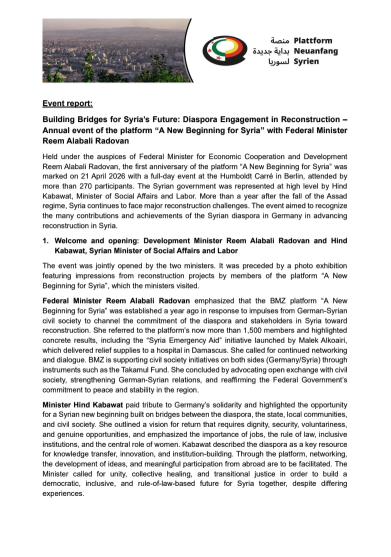
At the invitation of Federal Minister Reem Alabali Radovan, the first anniversary of the “A New Beginning for Syria” platform was celebrated on 21 April 2026 with a full-day event at Humboldt Carré in Berlin, attended by more than 270 participants. The Syrian government was represented at a high level by Hind Kabawat, Minister of Social Affairs and Labour. The aim of the event was to acknowledge the many contributions and achievements of the Syrian diaspora in Germany in promoting reconstruction in Syria and to foster exchange and networking among the Syrian diaspora in Germany.
Reem Alabali Radovan opens a photo exhibition featuring images of reconstruction projects to mark the first anniversary of the platform “A new Beginning for Syria”.
Copyright© Juliane Sonntag/Photothek

The two ministers jointly opened the event and visited a photo exhibition showcasing reconstruction projects in Syria that were initiated over the past year by the Syrian diaspora in Germany. In her opening speech, Development Minister Reem Alabali Radovan emphasized that the BMZ “A New Beginning for Syria” platform had been established one year ago in response to impulses from the German-Syrian civil society, with the aim of pooling and connecting the many initiatives of the diaspora and actors in Syria working on reconstruction. Minister Alabali Radovan advocated for open dialogue between politics and civil society and reaffirmed the German Federal Government’s commitment to peace and stability in Syria and the region. Minister Hind Kabawat paid tribute to Germany’s solidarity and highlighted the opportunities of a Syrian new beginning, for which exchange between the diaspora, the state, local communities and civil society is essential. Kabawat described the diaspora as a key resource for knowledge transfer, innovation and institutional development in Syria.
Afterwards, the two ministers held a discussion with three representatives of the Syrian diaspora, who presented their German-Syrian reconstruction initiatives: Robel Mutlu (Syriac Cross), Aziz Ramadan (DOZ e.V.) and Farah Khalifeh (Abjad Initiative for Education e.V.).
Panel discussion with Development Minister Reem Alabali-Radovan, Minister Hind Kabawat, Robel Mutlu (Syriac Cross), Aziz Ramadan (DOZ e.V.), and Farah Khalifeh (Abjad Initiative for Education e.V.).
Copyright© Juliane Sonntag/Photothek

In the subsequent panel discussion with Martin Russel (The Diaspora Institute), Bahjat Hajjar (Deputy Minister, Syrian Ministry of Social Affairs and Labour), Ashraf Rajab (Madaniya), Hafiza Hamoud (Mehad Germany e.V.) and Thomas Müller (GIZ), the potential of diaspora engagement was discussed from the perspectives of academia, the Syrian government, civil society and implementing organisations. In addition, more than 30 organisations presented their German-Syrian initiatives and projects at the “marketplace of engagement”, giving participants an insight into the diverse engagement of the Syrian diaspora in shaping future perspectives in Syria. The format created space for exchange, networking and potential cooperation. In parallel, an advisory format was offered to address questions on project development and implementation, with Ulrike Lauerhaß (Advisor, Development Cooperation Small-Scale Projects Fund at Stiftung Nord-Süd-Brücken) and Stephan Clauß (Technical Advisor on project applications at bengo/Engagement Global).
In the afternoon, participants engaged in intensive discussions in four different breakout sessions. During the fishbowl discussion “Achieving More Together: The European Diaspora in Syria’s Reconstruction”, the combination of two perspectives was highlighted as a particular asset: the diaspora’s access to European discourse spaces on the one hand, and their knowledge of local realities in Syria on the other.
The fishbowl discussion “Achieving More Together: The European Diaspora in Syria’s Reconstruction.”
Copyright© SANA / Baraa Alrazouk

The women-only workshop “Women from the Diaspora in Syria’s Reconstruction” was based on the key insight that reconstruction will remain incomplete without the participation of women. Participants pointed out that the diverse life realities of women have so far not been adequately taken into account.
The group “Economic Engagement for Syria’s Reconstruction” brought together platform members working in the private sector. They discussed key obstacles to engagement by private sector actors from the diaspora in Syria and identified possible solutions.
In the workshop “Syria 2035 – Civic Education and Participation”, participants first developed a joint 2035 vision for a Syria in which political participation, social inclusion and civil society engagement are sustainably strengthened. Building on this vision, they used a backcasting approach to identify the key prerequisites and areas for action.
Discussion in the workshop room “Syria 2035 – Civic Education and Participation,” moderated by Majid Albunni.
Copyright© SANA / Baraa Alrazouk

The event impressively demonstrated the strong commitment and diversity of the Syrian diaspora and at the same time the urgent need for long-term support. The recommendations and needs expressed to the platform in the course of the event will be taken into account in the future planning of activities and in further developing the platform.
A detailed event report and the presentations are available for download below.



As at: 21/04/2026